4.5.14

“支那 style”

在銅鑼灣鬧市有人展示一系列內地遊客在街上便溺的照片,又播放以Gangnam Style 改編的歌曲,反覆地唱着“支那 style”。把“支那”譜進歌詞來唱,這些人是瘋了。我覺得他們很過分,相煎何太急。如果這不是歧視真的不知道甚麽才是歧視。街上便溺本就違法,見到時報警把他們拘捕就是,何須如此張揚諷刺。

內地人不見得在外國也都如此放肆,似乎這種事只在香港才有報導,那若不是來香港旅遊的文化程度偏低,就是他們愛跟我們對着幹。但做生意不能又愛人家的錢又嫌棄人家,這不是精神分裂麽?其實應該想想不如不做這生意吧。總有其他出路的吧?

1.5.14

貝果

在首爾美術館的咖啡室吃一個bagel要2500 韓圜,要cream cheese得另加1000 韓圜,共計合港幣約26元;而香港的星巴克一個bagel含cream cheese賣19港元。這麽看來首爾確實不便宜。當然,把兩地星巴克同一食物作比較會較為合理,但旅遊和日常生活並不是做研究,不能那麽科學化。

29.4.14

Seoul

I am now in Seoul. The city is much more tourist-friendly than when I first visited it solo over ten years ago. There is English on most signs in Seoul now. And there are Chinese characters too. But sometimes I can't help but wonder if the Chinese characters are supposed to be Chinese, or Japanese Kanji or their own Hanja. Sometimes the characters don't look quite right if they are meant to be Chinese.

blogentry-32-0-50186700-1398601409 blogentry-32-0-28858400-1398601478

There is something very wrong in the first picture, at least it is not in line with the common understanding as far as I know. I am not sure if it is intentional. Is the term 正体字 (not 正體字) used to refer to simplified characters at all?
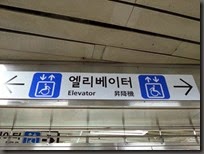
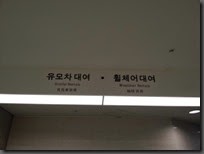
blogentry-32-0-98437100-1398601506 blogentry-32-0-45007600-1398601568

The 昇 in the picture above is wrong as far as I know. And I was quite speechless when I saw the sign 乳母車貸與. It couldn't be right, right? But I subsequently concluded that, as the Korean is 유모차 대어 (yumocha daeyeo), that should be Hanja. Someone also told me later that 昇降機 is the Hanja for 승강기, which according to Wiktionary is used as well as 엘리베이터 to refer to elevator.

It is probably that when the characters are meant to be Chinese, they will be in the simplified form and will be accompanied by Japanese. Otherwise the characters are Hanja.

I took the following picture at an exhibition featuring some Chinese artists at the Seoul Museum of Art. What I found interesting in the picture is how Chinese names are expressed in Korean.

blogentry-32-0-60775200-1398777208

I had assumed that a Chinese name would be expressed in its Korean equivalent, such as 李 as 이. But according to the picture it seems I was wrong. Here 李 in the name of the artist 李暐 has become 리 (which of course is still the standard in North Korea). And the most intriguing are the names 繆曉春 (미아오시아오춘 / mi.a.o.si.a.o.chun) and 張小濤 (잔시아오타오 / jang.si.a.o.ta.o). The iao and ao have become very clumsy syllables.

I wondered if the translation was based on the names in Hanyu Pinyin rather than the names in Chinese characters.  And someone told me that nowadays (modern South) Korean transliterates Chinese names from Pinyin rather than using Sino-Korean 音訓 eumhun, and it is standard for all non-historical figures.

27.4.14

首爾

在首爾有各種各樣的不習慣、不喜歡甚至痛苦。例如換乘地鐵吧,線與線、月台與月台之間的距離好像比巴黎地鐵更離譜、更過份,從一個地方到另一個地方所要花費的時間和精力令人沮喪。南韓明明是一個發達的國家,但生活各方面卻讓我感到水土不服,每一次到韓國都相當不適應。

還有,這麼多年沒來,發覺有些人還是那麼粗魯。說話不好好說話,總喜歡碰手碰腳的。

昨天給弟弟的短訊:“ 想返屋企。好唔鍾意呢道。” “ 搭地鐵轉車轉到傻。”

19.4.14

Xu Bing, Taipei

I went to the Xu Bing Retrospective in Taipei today, and am very glad that I did. I am sure there is a lot of information on the internet about his works, but I was fascinated all the same.

Many of his works are related to languages. Like his ABC series which is about representing English letters using Chinese characters.

blogentry-32-0-55027700-1397920714 blogentry-32-0-33457700-1397920674

Then there is the square word calligraphy series, which is about writing each English word in a square. I think the idea is similar to the Korean script, but the Xu Bing version is not as tidy, mainly because that unlike Korean, the number of components of each English word is not fixed. And some square words look quite messy, as there are just too many components (long words). I don't think it is a very creative series and the idea is not very different from the Chinese letters that tattooists use to con the uninformed. But it is fun, and is not difficult to learn and decipher. And, hey, it is Xu Bing.

blogentry-32-0-79701000-1397920974 blogentry-32-0-01976200-1397920806blogentry-32-0-10936600-1397920741 blogentry-32-0-29428500-1397921135

I can see in the photo above "square word" and "Xu Bing". And in the photo next to it, the first words (from left) are "four poems of W B Yeats, calligraphy by Xu Bing".

And then there is of course the 天書 series, which needs no introduction. I am not a big fan of his more recent 地書 series, though.

blogentry-32-0-44827300-1397921186

18.4.14

茶聖

聽從友人的推介去看了日本電影一代茶聖千利休,是非常美麗的電影,很好看。看了好電影覺得很開心。那一幕高麗人和日本人無法溝通,只能靠手寫漢字和白居易的詩交談,印象深刻。而他們寫的當然我們也看得懂,覺得如果現在也能這樣那多好(其實也可以,不過不是靠漢字而是用英語)。

我覺得這電影遠勝武士的菜單。

12.4.14

推窗

天氣和暖,幾個月來第一次打開陽台的玻璃門,鳥鳴聲、浪濤聲、還有鄰居娃娃的哭聲立刻湧入。把酒望海片刻,想起袁枚的詩。我大概也可以說:“海似相思久,推窗撲面來”吧。哈哈。

11.4.14

嚴苛

剛剛又參加了一次廉政公署的講座,跟以前一樣,覺得防賄條例非常嚴苛,近似惡法。也跟以前一樣,聽了講座之後總是非常不安害怕。加上除了成文法,還有普通法,從判例才知道怎樣會犯法,教人好害怕。

乍暖還寒

今天最高氣溫有25度,於是換上一襲海軍藍的連身裙子和同色外套,遍體深藍,算是向藍天致敬。可是這身衣服除了質料輕薄,其實並無春天的氣色。街上的行人可不同了,不少女子裙裾飄飄、花紋多有春田花花,整個氣氛都不同了。只是在這種氣溫大多數人仍未可穿上短袖單衣(我若穿短袖必定着涼),更有人仍然踏着靴子呢。

29.3.14

好雨知時節

香港的亞洲協會就在港島金鐘山裏的前英軍軍火庫。雨後在正義道往山上走,鳥語花香,但覺春天潤物細無聲,甚麼意大利名畫,其實都不重要了。

正義道因是法院所在而得名,名字忒好。